
The Pak Global Pakistan:
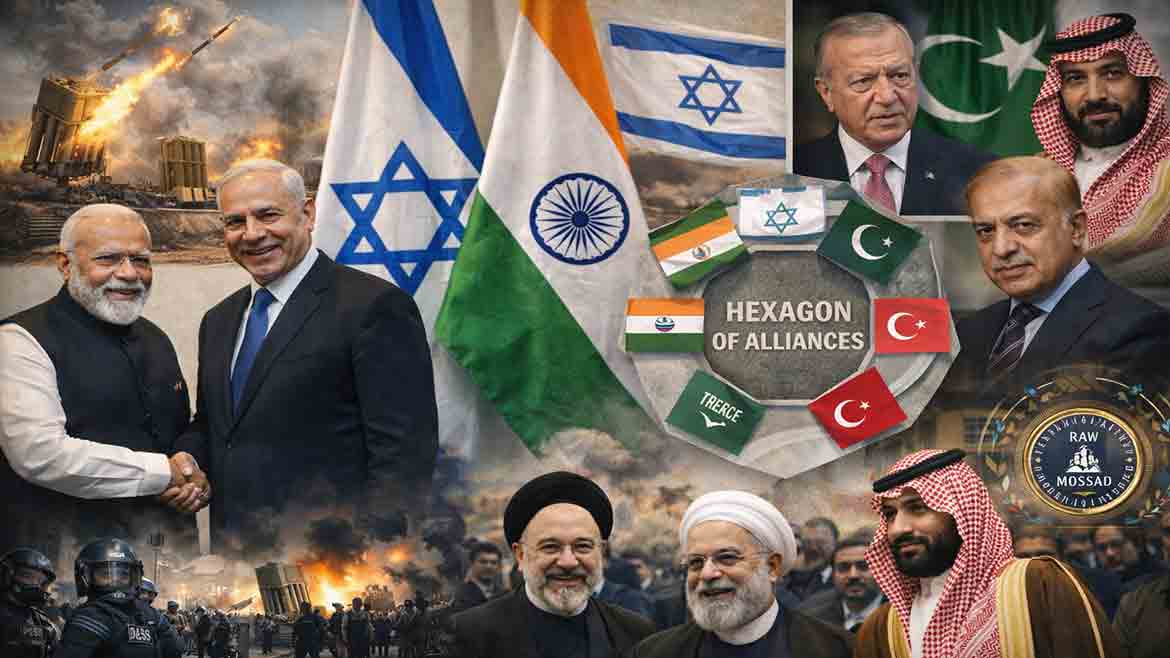
Islamabad, Pakistan – Indian Prime Minister Narendra Modi’s recent visit to Israel marks a significant milestone in the expanding strategic partnership between the two nations. Modi, welcomed with full honors by Israeli Prime Minister Benjamin Netanyahu, arrived amid a complex regional backdrop, including ongoing conflicts in Gaza and shifting alliances across the Middle East and South Asia.
Netanyahu introduced a “hexagon of alliances” concept, positioning India at the center alongside Greece, Cyprus, and other undisclosed Arab, African, and Asian countries. This framework aims to counter “radical axes,” including a “radical Shia axis” and an “emerging radical Sunni axis,” the latter perceived to include Turkey, Saudi Arabia, and Pakistan—nations with strong Sunni majorities and growing strategic ties.
India’s relationship with Israel has accelerated rapidly since Modi’s 2017 visit. Today, India is Israel’s largest arms buyer, with cooperation spanning defense, artificial intelligence, cybersecurity, and quantum computing. The two countries are reportedly finalizing agreements to export advanced military hardware, such as Israel’s Iron Beam laser weapon and Iron Dome missile defense technology, to India.
Former Pakistani diplomats Masood Khan and Masood Khalid note that Modi’s visit could lead to a strategic pact paralleling Pakistan’s 2025 defense agreement with Saudi Arabia. Khalid highlighted the military dimension, citing India’s use of Israeli drones in the 2025 India-Pakistan conflict and ongoing cooperation in defense and counterterrorism.
Netanyahu’s “hexagon” remains undefined, but analysts agree Pakistan’s close ties with Saudi Arabia and Turkey place it within Israel’s sphere of strategic concern. Intelligence sharing between India’s RAW and Israel’s Mossad, dating back decades, adds to Pakistan’s security worries.
However, some experts urge caution, suggesting Pakistan is more indirectly affected by this alliance through shared threat narratives rather than being a direct target. The Gulf region further complicates Pakistan’s position, given its economic reliance on Gulf states, some of which, like the UAE, have deepened ties with India.
Iran’s central role in regional tensions adds another layer of complexity. While the US and Israel pressure Iran over its nuclear and missile programs, Pakistan advocates for diplomatic solutions to ease hostilities.
Ultimately, Pakistan faces a strategic contest: balancing its alliances with Saudi Arabia and Turkey against the growing India-Israel partnership. Despite challenges, Pakistan maintains leverage through its defense capabilities and strengthened US ties, aiming to navigate the shifting geopolitical landscape.