

Article:
Last week, Pep Guardiola surprised a journalist by saying, “Do you want to be my assistant coach? You are brilliant, you are top.” The question posed sought insight into Manchester City’s evolving use of narrow and fluid attackers, a stark contrast to the wide roles of Leroy Sane and Raheem Sterling in the 2017-18 season.
Guardiola’s tactical shift reflects a deep-rooted philosophy dating back nearly two decades. In a 2006 article for El Pais, he analyzed Spain’s 3-1 victory over Tunisia, highlighting the challenges of breaking down low-block defenses. Guardiola noted that counter-attacks exploit space but concede ball possession, while attacking with the ball means less space and higher risk of turnovers—especially centrally.
At the start of this season, City leveraged the counter-attacking prowess of players like Erling Haaland and Tijjani Reijnders, scoring more fast-break goals than in the previous two campaigns combined. Yet, as physical and compact defenses became prevalent, Guardiola adjusted by emphasizing possession and minimizing risky direct play.
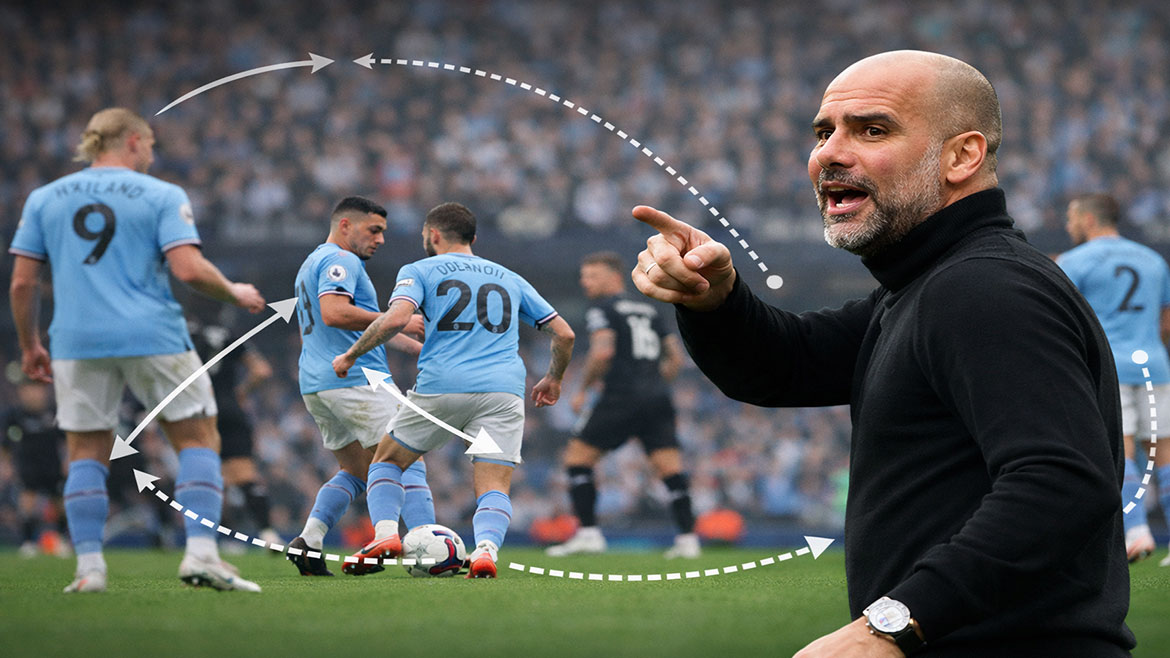
City’s recent 3-0 win over Fulham showcased a narrow and fluid front three, reminiscent of Luis Aragones’ Spain side known for tiki-taka. Guardiola described Spain’s forwards as “position-less,” a concept mirrored in City’s flexible attacking trio, supported by high and wide full-backs. This formation pins opponents back, limiting their pressing options and creating space for City’s midfielders to build attacks.
A key tactical nuance lies in the timing of attackers’ movements. Guardiola advises attackers to delay dropping deep to receive the ball, avoiding crowding the midfield and maintaining balance. This approach allows midfielders like Rodri to exploit space and orchestrate play effectively, while wide players capitalize on the space created as opponents are drawn inward.
Guardiola’s adaptability is evident in his player-centric approach. With just one traditional winger in Antoine Semenyo, City’s system evolves to suit the strengths of its personnel rather than rigidly adhering to a fixed style. This flexibility has allowed Guardiola to reinvent his team multiple times while maintaining his core principles of possession dominance and spatial control.
Despite changes on the pitch, Guardiola’s 2006 writings reveal a consistent tactical mindset focused on outmaneuvering compact defenses through patient build-up and intelligent positioning. His enduring philosophy, adapted to contemporary challenges, cements his status as one of football’s most innovative and successful managers.