
By The Pak Global Pakistan:
Deir el-Balah – While US President Donald Trump convened the inaugural meeting of his Board of Peace (BoP) in Washington, DC, Palestinians in Gaza were grappling with a far more urgent question on the ground: Will anything truly change their harsh reality?
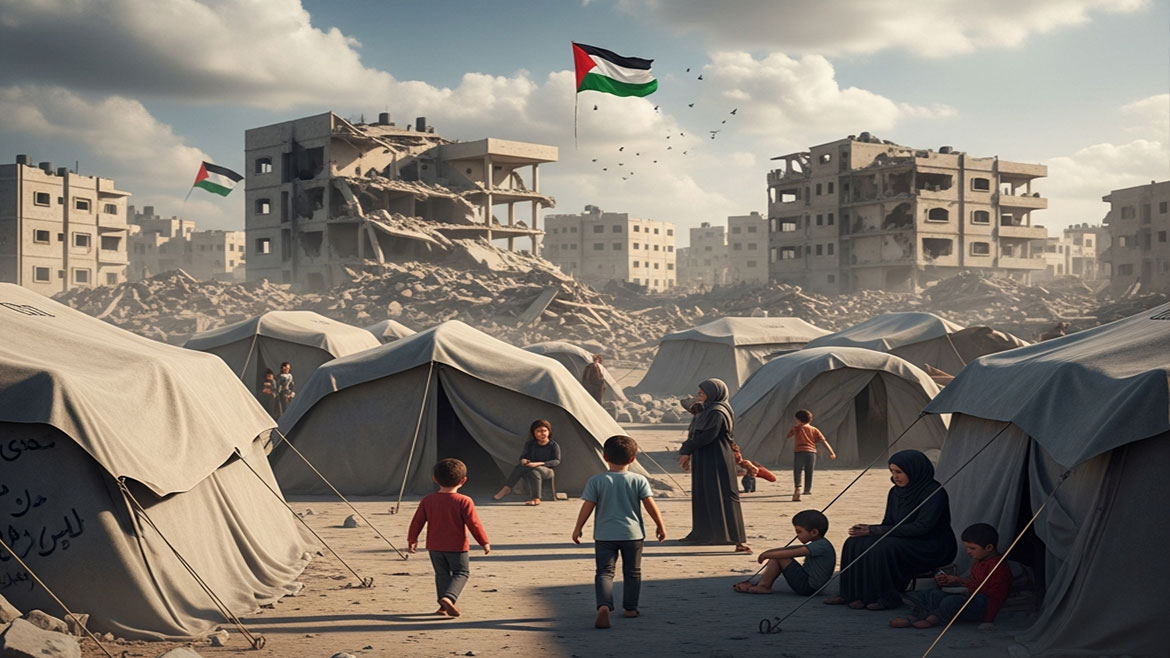
Across Gaza’s central and southern regions, where hundreds of thousands remain displaced and struggling, hope for immediate relief is scarce. Amal Joudeh, 43, a mother of eight living in a tent in Deir el-Balah, expressed frustration: “I’ve heard about money being collected for Gaza, but we see nothing. My house is gone, my husband and children are injured. We want support, reconstruction, any solution.”
At the Washington meeting, Trump announced pledges totaling $7 billion from nine nations to a Gaza reconstruction fund and the deployment of troops from five countries to an International Stabilisation Force. The US also promised a $10 billion contribution to the BoP, though details on its use remain vague.
However, these pledges fall far short of the UN’s $70 billion estimate needed to rebuild Gaza after over two years of devastating Israeli bombardment.
Many Palestinians, including 70-year-old Awad al-Ghoul who was displaced from Rafah, view the Board of Peace as a “club of major powers” disconnected from Gaza’s reality. “If this board cannot stop Israeli attacks in Gaza, how can it resolve global conflicts?” he questioned.
Skepticism about aid is widespread. Al-Ghoul fears much of the pledged money will be lost to administrative costs, benefiting officials rather than Palestinians. Jamal Abu Makhdeh from Deir el-Balah echoed the sentiment, calling the board’s promises lies and asserting, “Anything Israel agrees to won’t be in our interest.”
Israeli restrictions on construction materials have long hindered Gaza’s reconstruction, despite repeated ceasefire agreements. Since last October’s truce, over 600 Palestinians have been killed by Israeli gunfire, with basic services like health, education, and sanitation almost nonexistent.
Abu Makhdeh expressed distrust in the board, especially with Israel as a member. He warned that disarming Hamas, a key demand in the truce, aims to deepen internal Palestinian divisions. “There is no optimism in American decisions. This is just media talk,” he said.
Some, like Al-Ghoul, cautiously hope the proposed international peacekeeping force could deter Israeli attacks, similar to the UN’s role in Lebanon.
For displaced Palestinians like Amal Joudeh, the ultimate desire is simple: a dignified life and safe homes for their children. “I hope to see schools reopen, children return to classrooms, and to move out of tents,” she said.
Reconstruction was notably absent from the board’s announcements, raising concerns that without cessation of Israeli hostilities, rebuilding efforts will be futile.
Al-Ghoul summarized the collective yearning: “What matters is that the army withdraws and we return to our places.” Abu Makhdeh added, “We demand justice, peace, and a simple life with safety. We are exhausted.”
As the Board of Peace begins its journey, Gaza’s displaced stand resolute in their demand for tangible change, wary of promises but hopeful for relief.