

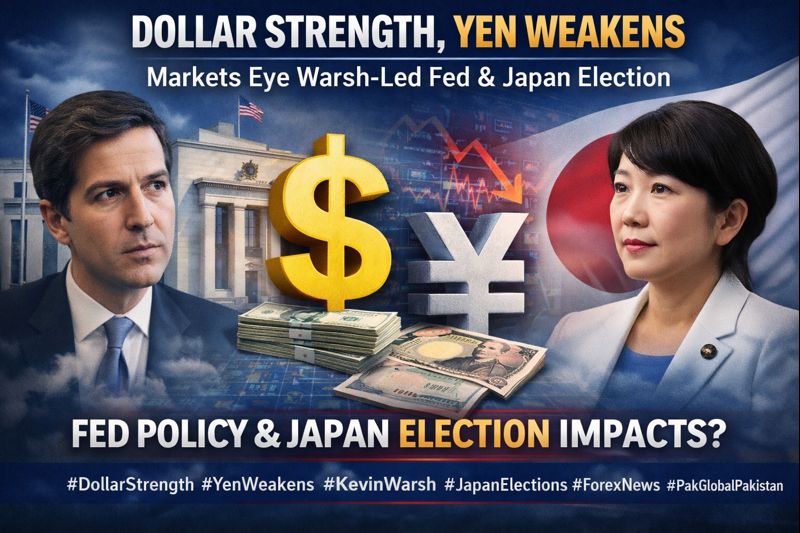
SINGAPORE (The Pak Global Pakistan) – The US dollar maintained its recent gains on Monday as investors assessed the potential policy direction of the Federal Reserve under Kevin Warsh, who has been nominated by US President Donald Trump to serve as the next Fed Chair.
Market participants believe Warsh may favour interest rate cuts in the near term but adopt a more cautious stance later, particularly by shrinking the Federal Reserve’s balance sheet — a move that typically supports the dollar by tightening money supply conditions.
The nomination triggered sharp reactions in global markets late last week, with risky assets facing heavy selling pressure and precious metals tumbling. Meanwhile, the dollar recovered losses and strengthened across major currencies.
During early Asian trading, the greenback remained strong, keeping the euro well below the $1.20 mark, trading at around $1.1848. The British pound edged down 0.05% to $1.3680, while the dollar index held steady near 97.22 after rising nearly 1% on Friday.
Richard Clarida, global economic advisor at PIMCO and former US Federal Reserve Vice Chair, said Warsh would inherit a divided Federal Open Market Committee, particularly over the pace and scale of further monetary easing. However, Clarida expects Warsh to deliver at least two interest rate cuts this year, with the possibility of a third depending on inflation trends.
“Beyond the next two or three rate cuts, Warsh may become more cautious, especially if inflation risks persist,” Clarida noted. He added that Warsh is also less likely to rely heavily on forward guidance when signalling future interest rate moves.
Elsewhere in currency markets, the Australian dollar declined 0.54% to $0.6925, while the New Zealand dollar slipped 0.3% to $0.6001, pressured by the stronger US dollar.
Yen Under Pressure
The Japanese yen weakened further on Monday, falling around 0.4% to 155.39 per dollar, weighed down by dollar strength and political developments in Japan.
Japanese Prime Minister Sanae Takaichi drew attention over the weekend after highlighting the economic benefits of a weaker yen during a campaign speech — comments that contrasted with Japan’s finance ministry efforts to stabilise the currency.
A recent Asahi newspaper survey suggested Takaichi’s party could secure a landslide victory in the upcoming lower house election scheduled for February 8.
Market analysts say the election outcome could be a key catalyst for the yen. Tony Sycamore, a market analyst at IG, said a strong ruling-party mandate could push the dollar-yen pair toward the 160 level, while a coalition outcome might keep it closer to 155.
In the run-up to the election, investors have been selling the yen and Japanese government bonds, anticipating more expansionary fiscal policies if Takaichi secures a strong mandate. Proposed tax cuts could further strain Japan’s already stretched public finances.
Despite recent weakness, the yen has shown signs of stabilisation, as traders remain cautious about the possibility of coordinated currency intervention by the United States and Japan. Such concerns resurfaced after reports of rate checks by both governments last month briefly boosted the Japanese currency.