

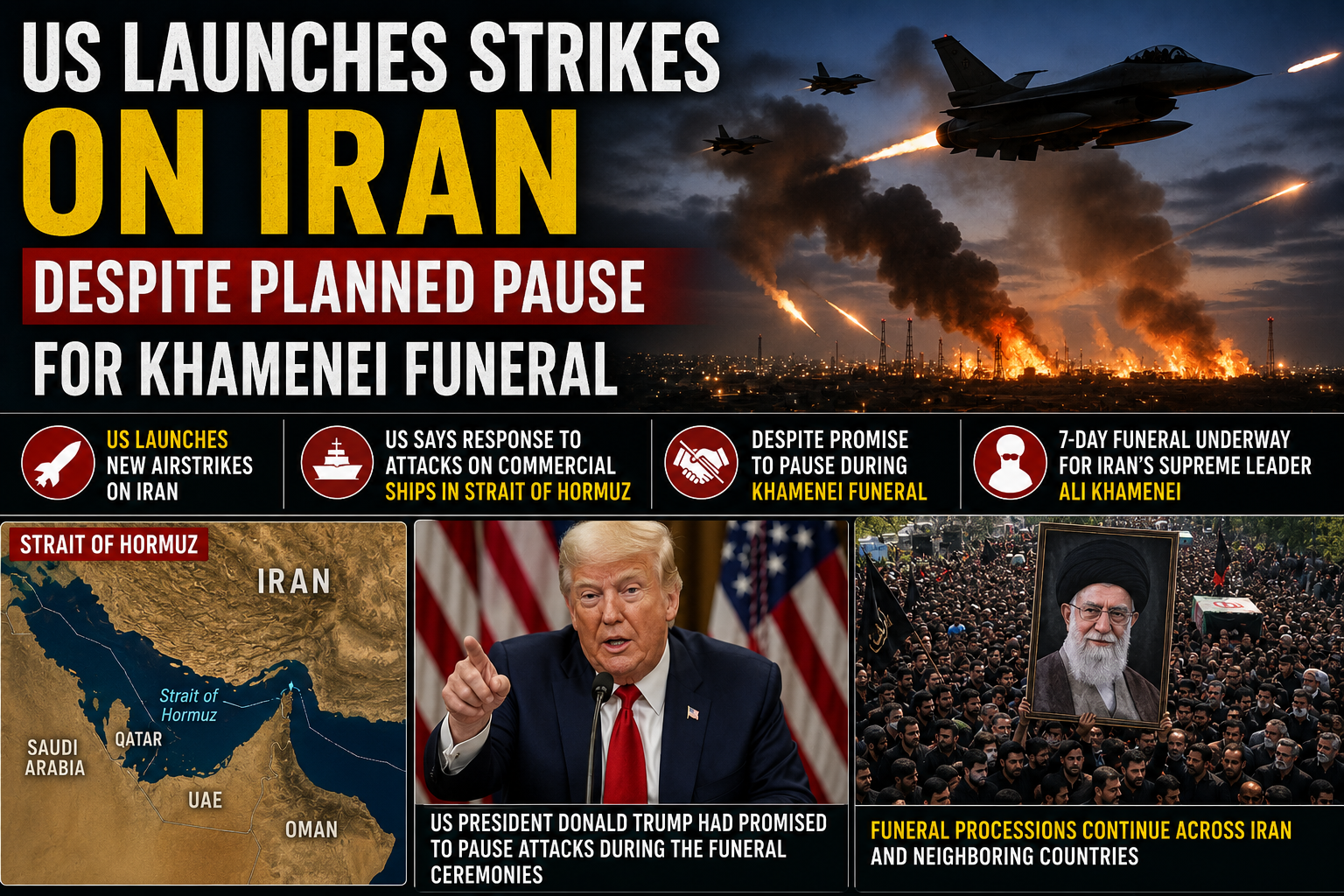
US Launches Strikes on Iran Despite Planned Pause for Khamenei Funeral
US Launches Strikes on Iran Despite Planned Pause for Khamenei Funeral
The United States has launched a fresh wave of airstrikes on Iran despite an earlier promise by US President Donald Trump to suspend military operations during the seven-day funeral period for Iran’s Supreme Leader, Ayatollah Ali Khamenei. The latest attacks have intensified already high tensions between Washington and Tehran, raising fresh concerns about the possibility of a wider conflict across the Middle East.
US officials said the strikes were carried out in response to attacks on commercial vessels passing through the Strait of Hormuz, one of the world’s busiest oil shipping routes. According to Washington, protecting international maritime traffic remains a top priority as security risks continue to grow in the Gulf region.
Iran, however, condemned the strikes, accusing the United States of breaking its commitment to pause military operations during the national mourning period. Iranian officials described the attacks as a violation of diplomatic understandings and warned that the country would respond if further military action continued.
US Resumes Military Operations Against Iran
The latest US military action targeted locations inside Iran after American officials blamed Tehran for attacks on commercial ships operating in the Strait of Hormuz. Washington described the operation as a defensive response aimed at protecting international shipping lanes and regional security.
US military officials stated that intelligence indicated growing threats against merchant vessels, including oil tankers linked to Gulf countries. The strikes were presented as part of broader efforts to maintain freedom of navigation in one of the world’s most strategically important waterways.
Despite earlier reports that military operations would pause during the funeral ceremonies of Ayatollah Ali Khamenei, the United States moved forward with the operation, arguing that recent maritime attacks required an immediate response.
Iran Condemns the Airstrikes
Iran strongly criticized the latest US attacks, saying they violated the announced pause during the funeral of the country’s late supreme leader.
Iranian government officials accused Washington of deliberately escalating tensions during a period of national mourning. According to Tehran, the strikes demonstrate that the United States is unwilling to respect diplomatic commitments despite previous discussions aimed at reducing hostilities.
Iran’s Islamic Revolutionary Guard Corps (IRGC) warned that continued attacks on Iranian territory would receive a strong military response. Officials stated that the country’s armed forces remain fully prepared to defend Iran’s sovereignty and national security.
Why the Strait of Hormuz Matters
The Strait of Hormuz remains one of the world’s most strategically important maritime routes. Nearly one-fifth of global oil shipments pass through the narrow waterway connecting the Persian Gulf with international markets.
Any military escalation in the region immediately raises concerns about global energy supplies, shipping costs, and oil prices.
US officials said attacks on several commercial ships passing through the Strait prompted the latest military action. Washington argued that ensuring safe navigation for international vessels is essential for global economic stability.
Security analysts believe prolonged tensions in the Strait could disrupt international trade and create additional uncertainty in global energy markets.
Funeral of Ayatollah Ali Khamenei Continues
The military developments occurred while funeral ceremonies for Iran’s late Supreme Leader, Ayatollah Ali Khamenei, continued across Iran and neighboring Iraq.
Millions of mourners have gathered during the multi-day funeral processions honoring the longtime Iranian leader. The ceremonies include religious events, public gatherings, and official state tributes attended by senior political and military officials.
Iranian leaders accused the United States of attempting to overshadow the funeral by launching military operations during the mourning period.
Officials described the timing of the strikes as disrespectful and warned that it could further damage already strained diplomatic relations.
Regional Tensions Continue to Rise
The latest exchange between Iran and the United States has significantly increased concerns throughout the Middle East.
Countries hosting US military bases have strengthened security measures while monitoring developments closely. Gulf nations remain concerned that additional military operations could spread beyond Iran and directly affect neighboring countries.
International observers have urged both Washington and Tehran to avoid further escalation and return to diplomatic negotiations before the conflict expands into a broader regional crisis.
Military analysts also warn that continued exchanges could increase risks for international shipping, aviation, and energy infrastructure across the Gulf.
Global Markets Watch the Situation
Financial markets reacted cautiously following reports of the renewed military strikes.
Energy traders continue monitoring developments because any disruption in the Strait of Hormuz could reduce global oil supplies and increase crude oil prices.
Shipping companies are also reviewing security procedures for vessels traveling through the Gulf as insurers evaluate the growing regional risks.
Economists believe prolonged instability could have broader consequences for international trade and global economic growth.
International Community Calls for Restraint
Several governments and international organizations have called for immediate de-escalation.
Diplomatic officials continue encouraging both countries to return to dialogue instead of military confrontation. Analysts argue that diplomatic engagement remains the most effective path toward reducing tensions and preventing further violence.
While both Iran and the United States continue presenting different versions of recent events, independent verification of battlefield claims remains limited.
Conclusion
The decision by the United States to launch fresh airstrikes despite an announced pause during Ayatollah Ali Khamenei’s funeral has added another chapter to the growing confrontation between Washington and Tehran. US officials maintain the strikes were necessary following attacks on commercial ships in the Strait of Hormuz, while Iran accuses Washington of violating its commitment and escalating regional instability.
As diplomatic efforts continue alongside military developments, the coming days will be critical in determining whether tensions can be contained or whether the conflict will expand further across the Middle East.
For more updates, visit Reuters: https://www.reuters.com/world/middle-east/
Read additional coverage on Al Jazeera: https://www.aljazeera.com/middle-east/
Latest international news is also available on AP News: https://apnews.com/hub/middle-east
