By The Pak Global Pakistan
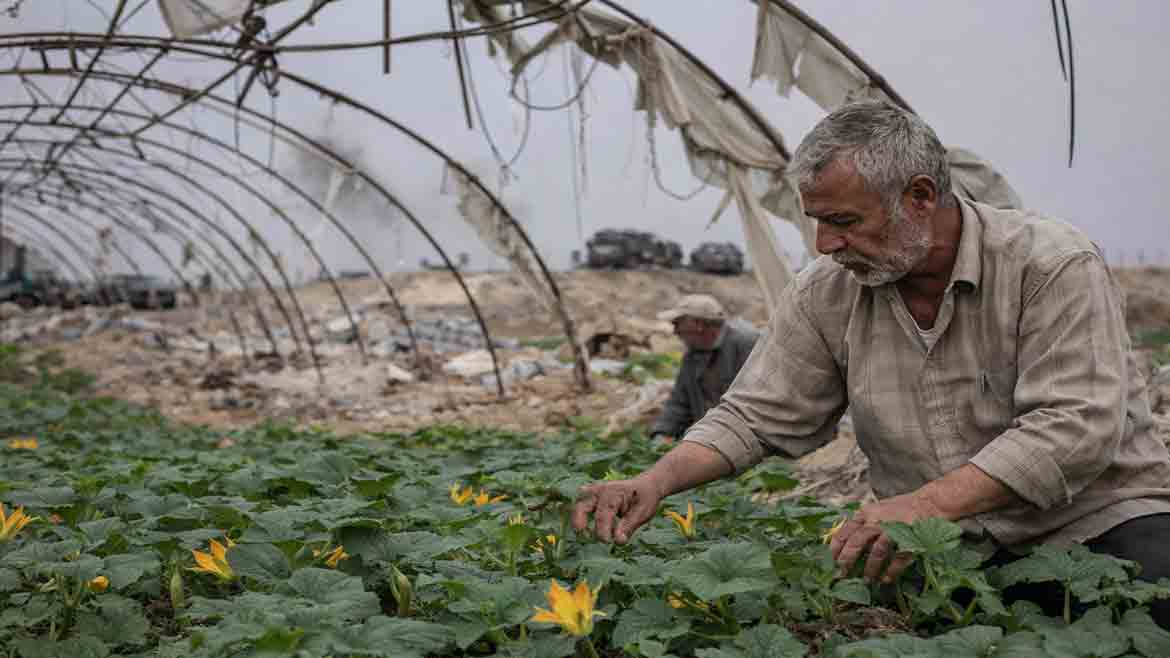
Gaza Strip – As the ceasefire in Gaza took effect in October, Palestinian farmer Mohammed al-Slakhy returned to his farmland in the Zeitoun area of Gaza City, hoping to restore the family farm that had been destroyed after more than two years of conflict. Despite the temporary calm, daily life remains fraught with danger, as Israeli tanks and sporadic gunfire continue to loom just hundreds of metres from his fields.
Mohammed and his family spent months clearing debris from their leveled greenhouses and rebuilding the soil to plant their first courgette crop, with hopes of harvesting by early spring. Before the war, the farm produced high-quality vegetables for local markets and exports to the West Bank. Now, only one hectare of the original 22 hectares is accessible, as the remainder falls within a so-called Israeli buffer zone.
The agricultural destruction in Gaza is widespread. According to the United Nations Food and Agriculture Organization (FAO), over 80 percent of cropland has been damaged, with less than 5 percent remaining cultivable. Israeli forces continue to maintain control over 58 percent of the Gaza Strip, including much of the fertile farmland in the east, north, and south.
Incidents of violence persist. On February 12, Mohammed narrowly escaped being hit when Israeli tanks advanced on Salah al-Din Street and opened fire. Similarly, 75-year-old farmer Eid al-Taaban in Deir el-Balah has been unable to access his eggplant crops after the buffer zone’s expansion, fearing for his family’s safety with daily gunfire nearby.
Tragic deaths underline the ongoing risks. On February 6, Palestinian farmer Khaled Baraka was killed while working his land in eastern Deir el-Balah. His neighbor Eid al-Taaban remembered him as a dedicated farmer who spent his life cultivating land and teaching the next generation.
For Gaza’s farmers, returning to the land is both a necessity and a peril. With limited access, destroyed infrastructure, and ongoing military threats, the struggle to rebuild livelihoods highlights the broader humanitarian crisis facing the region.