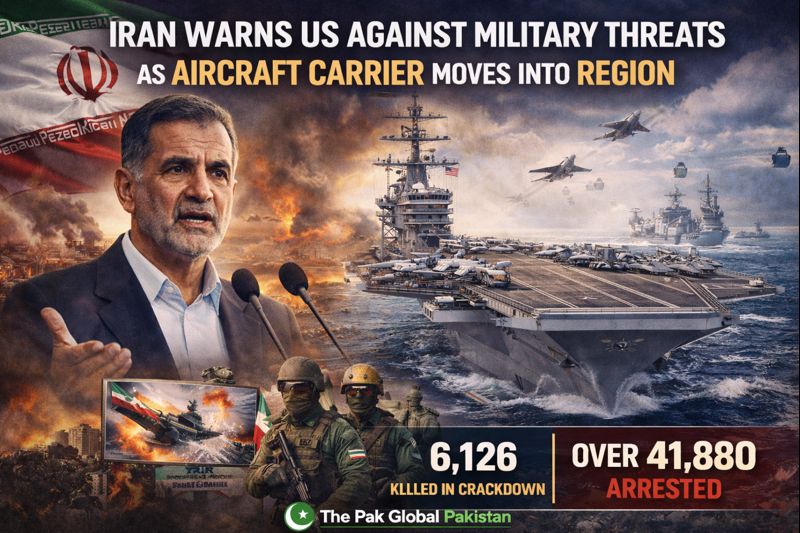
PARIS (The Pak Global Pakistan) – Iranian President Masoud Pezeshkian on Tuesday warned that continued US threats against Iran would only deepen instability across the Middle East, as a US naval strike group led by an aircraft carrier moved into the region amid rising tensions.
The warning comes after US President Donald Trump ordered the deployment of the USS Abraham Lincoln to Middle Eastern waters, signalling that Washington has not ruled out military action against Tehran over its ongoing crackdown on nationwide protests.
Speaking during a phone call with Saudi Crown Prince Mohammed bin Salman, President Pezeshkian said US threats were “aimed at undermining regional security” and would result in “nothing but instability.”
The United States maintains several military bases across the Middle East, prompting Iran’s Islamic Revolutionary Guard Corps (IRGC) to issue a stark warning to neighbouring countries.
“Neighbouring countries are our friends, but if their land, airspace, or waters are used against Iran, they will be treated as hostile,” said Mohammad Akbarzadeh, political deputy of the IRGC naval forces, according to Iran’s Fars news agency.
Mixed Signals From Washington
Since Iran launched a sweeping crackdown on protests earlier this month—accompanied by a near-total internet blackout—President Trump has delivered mixed messages on possible intervention. While some opposition groups believe foreign action is the only path to change, Trump has alternated between threats and hints of diplomacy.
“We have a big armada next to Iran,” Trump told Axios on Monday. “But they want to make a deal. I know they do. They’ve reached out many times.”
Despite the absence of formal diplomatic ties, Tehran has previously acknowledged the existence of indirect communication channels between Iranian Foreign Minister Abbas Araghchi and US envoy Steve Witkoff.
According to Axios, Trump declined to publicly discuss military options presented by his national security team. Analysts suggest these range from limited strikes on military targets to direct attacks aimed at dismantling Iran’s ruling system under Supreme Leader Ayatollah Ali Khamenei.
‘Weakest Point Since 1979’
The New York Times reported that US intelligence assessments indicate Iran’s leadership is under unprecedented pressure, describing the regime’s grip on power as its weakest since the 1979 Islamic Revolution.
US Senator Lindsey Graham said the ultimate objective discussed with Trump was “ending the regime,” arguing that any pause in repression would be temporary if the current leadership remains in control.
Iranian officials, meanwhile, have appeared cautious about further escalation. However, Iranian media briefly quoted an IRGC spokesman as warning that any US aircraft carrier entering Iranian territorial waters would be targeted—a statement later retracted with an apology.
Conservative outlets in Iran have also suggested that Tehran could respond by closing the Strait of Hormuz, a critical chokepoint for global energy supplies. An anti-US billboard depicting the destruction of an American aircraft carrier has appeared in Tehran.
Deadly Crackdown and Mass Arrests
Human rights groups describe the ongoing repression as the deadliest crackdown on protests in Iran’s history, noting that a prolonged internet blackout has made verification difficult.
According to Human Rights Activists News Agency (HRANA), at least 6,126 people have been confirmed killed, including 5,777 protesters, 86 minors, 214 security personnel, and 49 bystanders. The group said it is still investigating more than 17,000 additional possible deaths.
HRANA also reported that over 41,880 people have been arrested, accusing security forces of relying on mass arrests, intimidation, and information control.
Meanwhile, Netblocks reported limited restoration of internet access but warned connectivity remains heavily restricted. Iran International, a Persian-language channel based abroad, has claimed far higher casualty figures, though those reports could not be independently verified.