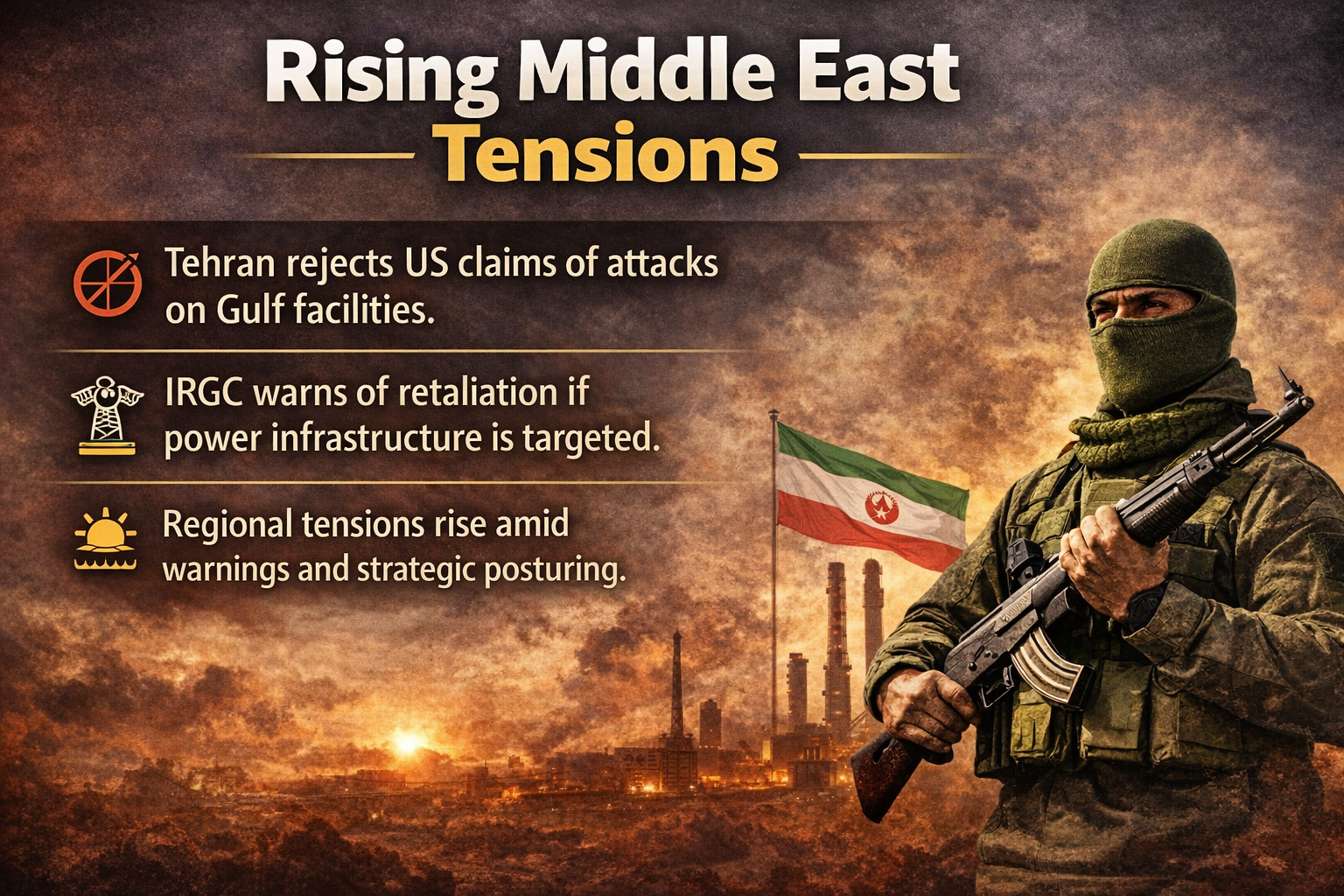
Iran IRGC response to US claims sparks rising Middle East tensions
IRGC Rejects Allegations About Gulf Infrastructure
The Islamic Revolutionary Guard Corps (IRGC) has strongly denied recent claims made by the United States suggesting that Tehran is planning to target water desalination plants in the Gulf region. According to the IRGC, these accusations are inaccurate and misleading, and do not reflect Iran’s actual position.
In an official statement, the organization emphasized that Iran has no intention of attacking civilian infrastructure such as water facilities. Instead, it described the allegations as part of a broader narrative aimed at increasing pressure on Tehran during a period of heightened regional tensions.
Iran’s Warning on Power Infrastructure Attacks
Retaliation Strategy Explained
The IRGC outlined a clear position regarding potential military escalation. It stated that if Iran’s power plants or energy infrastructure were to be targeted, the country would respond by focusing on similar facilities linked to its adversaries.
This includes, according to the statement, electricity and energy installations associated with Israel, as well as infrastructure in regional countries that support U.S. military bases. The IRGC also mentioned that economic and industrial assets involving American interests could be considered in any retaliatory action.
This approach reflects a strategy of proportional response, where any attack would be met with a similar level of force targeting comparable sectors.
Focus on Deterrence
The IRGC stressed that its stance is based on deterrence rather than escalation. By clearly communicating the potential consequences of targeting Iran’s infrastructure, the organization aims to discourage any such actions from taking place.
Officials highlighted that maintaining balance in response is a key part of their defense strategy. The goal, they indicated, is not to initiate conflict but to ensure that any aggression is met with an equivalent reaction to prevent further escalation.
Denial of Attacks on Civilian Facilities
Addressing Past Incidents
In its statement, the IRGC also rejected accusations linking Iran to attacks on civilian locations, including hospitals, aid centers, and schools. It maintained that these incidents were not carried out by Iranian forces and should not be attributed to Tehran.
By distancing itself from such actions, the organization sought to reinforce its position that it does not deliberately target civilian infrastructure. This messaging appears aimed at countering international criticism and maintaining a degree of legitimacy in the ongoing narrative.
Conditional Warning Issued
Despite denying involvement in past incidents, the IRGC issued a strong warning regarding future developments. It stated that if Iran’s electricity infrastructure is attacked, it would respond by targeting similar systems.
This conditional warning underscores the seriousness of the situation and highlights the potential for escalation if critical infrastructure becomes a focus of military actions.
Rising Regional Tensions
A Fragile Situation
The latest statements come amid increasing tensions in the Middle East, where geopolitical rivalries and security concerns continue to create uncertainty. The involvement of major powers and regional actors has made the situation more complex, with infrastructure emerging as a key point of vulnerability.
Energy facilities, in particular, are seen as strategic assets, and any threat to them carries significant economic and political consequences. 
Uncertainty Ahead
The IRGC concluded its statement by asserting that the United States may be underestimating Iran’s capabilities. It warned that any confrontation would reveal the extent of Iran’s preparedness and response capacity.
As the situation develops, the possibility of further escalation remains a concern for the international community. Observers continue to watch closely, as any miscalculation could have wide-reaching impacts across the region.Iran IRGC response to US claims
The statement reflects a firm and calculated stance by the Islamic Revolutionary Guard Corps, emphasizing its commitment to proportional response and strategic deterrence. By highlighting that any threat will be met at an equivalent level, the IRGC is signaling that it seeks to maintain balance rather than escalate unnecessarily. The remark that the United States underestimates Iran’s capabilities suggests confidence in its military readiness and regional influence. This message is likely intended not only for Washington but also for regional actors, reinforcing the idea that any confrontation could carry significant consequences and would not go unanswered in practice.