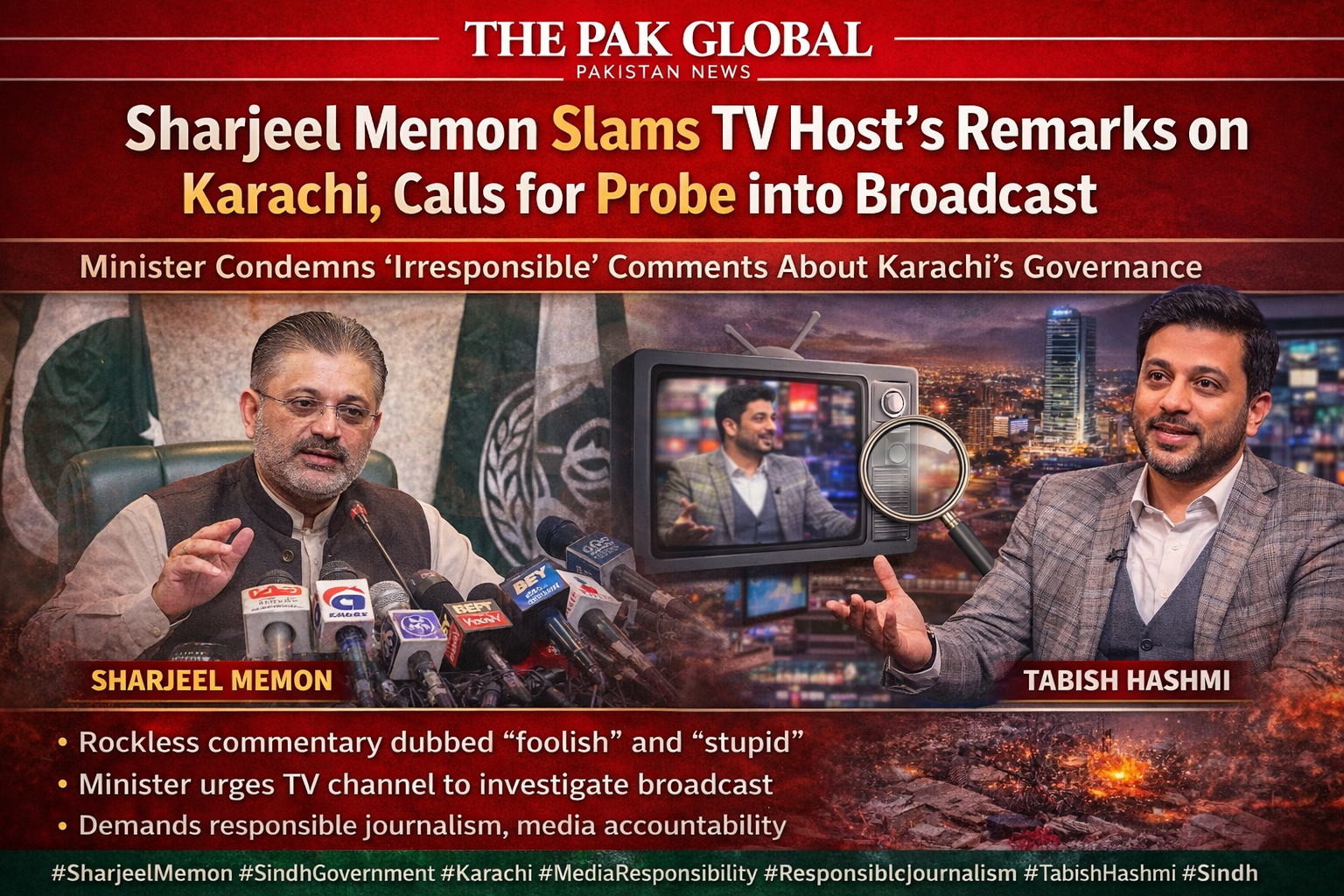
The Pak Global Pakistan News | Web Desk
Sindh Senior Minister Sharjeel Inam Memon has strongly condemned controversial remarks made by television host Tabish Hashmi regarding Karachi’s governance, calling them irresponsible and misleading.
Speaking to the media, Sharjeel Memon expressed serious concern over what he described as reckless commentary aimed at Karachi and the province of Sindh. Without naming the host directly, he dismissed the remarks as “foolish” and “stupid,” questioning the speaker’s understanding of constitutional law and Pakistan’s federal structure.
“The person making such statements has neither studied the Constitution nor understands Sindh’s historical, geographical, and constitutional importance,” the senior minister said. He added that the comments reflected a “serious lack of awareness” about Sindh’s role within the federation of Pakistan.
Sharjeel Memon urged the private television channel that aired the programme to launch an internal investigation into the matter and take appropriate disciplinary action. Emphasizing media responsibility, he stated that television networks must ensure responsible journalism and refrain from spreading narratives that could mislead the public or undermine provincial integrity.
The controversy arose after Tabish Hashmi commented on Karachi’s governance in the aftermath of the tragic Gul Plaza fire incident. During the programme, Hashmi suggested that Karachi should be privatised, drawing a comparison with the government’s move to privatise Pakistan International Airlines (PIA).
“If the government accepted that it could not run PIA and chose to privatise it, then Karachi should also be privatised,” Hashmi said. He further remarked that residents of Karachi — including Pathan, Baloch, Sindhi, Muhajir, and Punjabi communities — could manage the city themselves.
“It cannot be run worse than this,” he added, claiming that citizens would govern the metropolis more effectively.
The remarks sparked immediate backlash, particularly from Sindh government officials and political stakeholders, who viewed the comments as an attack on provincial authority and constitutional governance.
The issue has reignited debate over media accountability, freedom of expression, and the sensitive nature of discussions surrounding Karachi’s administration and Sindh’s constitutional status.