

IEA Warns Global Oil Demand Could See First Decline Since 2020 Amid US-Iran Conflict
The International Energy Agency (IEA) has warned that global oil demand could experience its first annual decline since 2020, as the ongoing US-Iran conflict continues to disrupt energy markets. Rising crude oil prices, shipping delays, and uncertainty across the Middle East are creating serious challenges for the global economy.
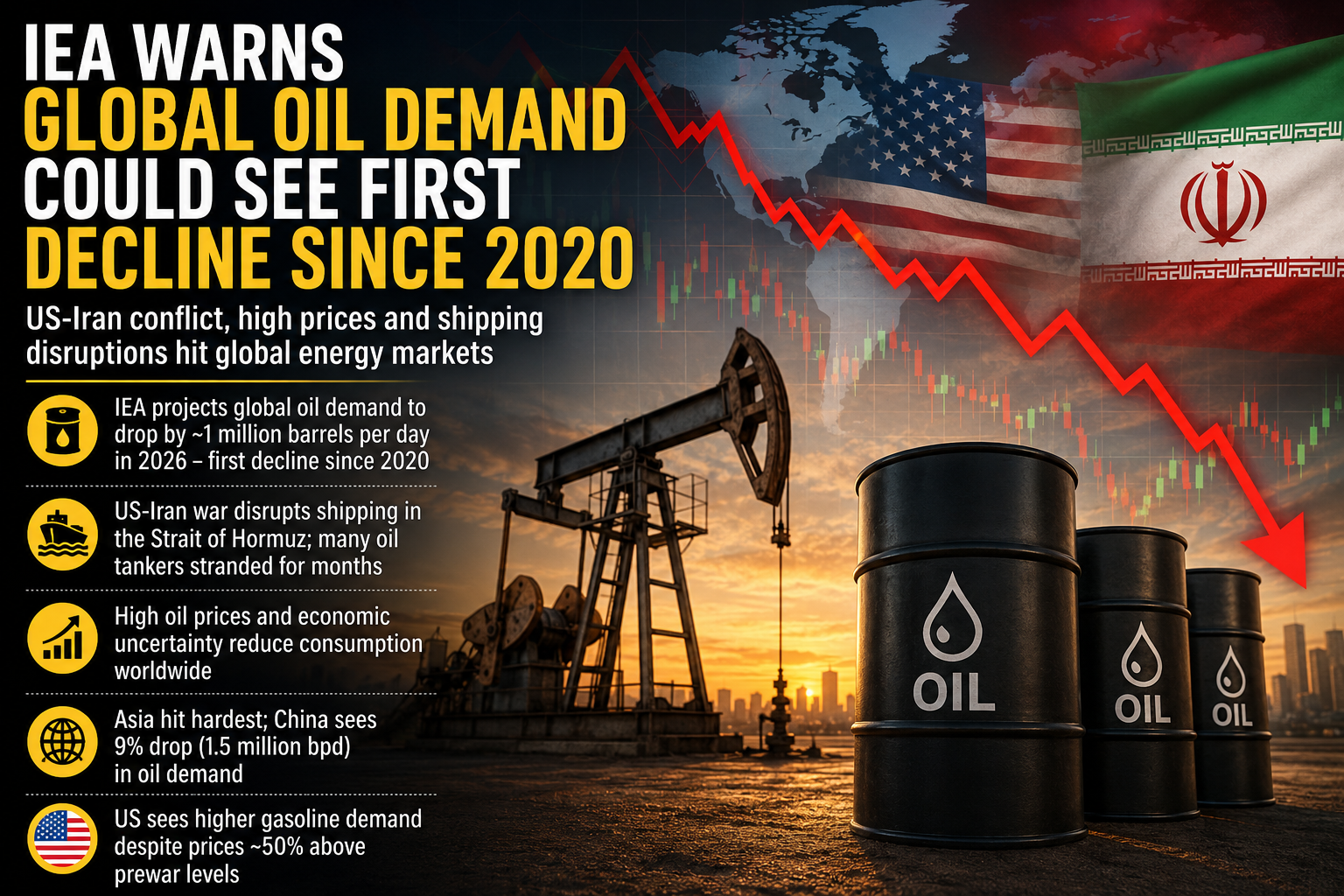
According to the latest market estimates, worldwide oil demand is expected to fall by around one million barrels per day in 2026. If the forecast proves accurate, it will mark the first yearly decline since the COVID-19 pandemic caused an unprecedented collapse in energy consumption.
The report highlights that geopolitical tensions, particularly in the Gulf region, are becoming one of the biggest threats to global energy security.
IEA Warns Global Oil Demand Could See First Decline Since 2020
The International Energy Agency believes the current slowdown is mainly linked to the ongoing conflict between the United States and Iran. The war has significantly affected oil transportation routes, especially through the Strait of Hormuz, one of the world’s most important oil shipping lanes.
Millions of barrels of crude oil pass through this narrow waterway every day. However, increased military activity and security concerns have forced many oil tankers to delay or cancel shipments.
As a result, supply chains have been disrupted, transportation costs have increased, and crude oil prices have remained volatile.
Energy analysts believe prolonged instability in the region could continue affecting oil markets for several months.
US-Iran Conflict Disrupts Global Oil Supply
The US-Iran conflict has created uncertainty across international energy markets.
Several crude oil tankers have reportedly remained stranded for months because shipping companies fear operating in high-risk areas. Insurance costs for vessels have also increased significantly, making international transportation more expensive.
The reduced movement of oil has limited global supply while simultaneously pushing fuel prices higher.
Countries that depend heavily on imported oil are facing growing pressure as governments attempt to control inflation and protect consumers from rising energy costs.
Strait of Hormuz Remains a Critical Energy Route
The Strait of Hormuz connects the Persian Gulf with international shipping routes and carries nearly one-fifth of the world’s oil exports.
Any disruption in this region immediately affects global energy markets.
With ongoing security concerns, shipping companies are operating cautiously, causing delays in crude oil deliveries to Asia, Europe, and other international markets.
Energy experts warn that continued instability could further increase transportation costs and reduce global oil availability.
Rising Oil Prices Affect Global Demand
Higher oil prices are one of the biggest reasons behind falling demand.
As crude oil becomes more expensive, businesses face higher transportation and production costs. Airlines, shipping companies, manufacturers, and logistics firms all experience increased operating expenses.
Consumers also reduce fuel consumption when petrol and diesel prices rise sharply.
The IEA expects these economic pressures to continue limiting global oil demand throughout 2026.
Inflation Adds More Pressure
Rising fuel costs are contributing to inflation in many countries.
Higher transportation expenses increase the prices of food, consumer goods, and industrial products. Central banks may also keep interest rates higher for longer to control inflation, slowing economic growth.
Together, these factors reduce industrial activity and lower overall oil consumption.
Asia Faces the Biggest Impact
Asia has suffered the largest decline in oil demand because many countries depend heavily on crude oil imports from the Middle East.
According to recent estimates, global oil consumption averaged 97.9 million barrels per day during May, representing a significant decrease compared to the previous year.
China recorded one of the sharpest declines, with oil demand falling by nearly 9 percent, equivalent to approximately 1.5 million barrels per day.
Other Asian economies also experienced weaker industrial activity due to higher energy prices and supply uncertainty.
China Sees Significant Slowdown
China remains one of the world’s largest oil consumers.
However, weaker manufacturing activity, slower economic growth, and rising fuel costs have reduced industrial demand for crude oil.
Lower factory production and declining transportation activity have further contributed to falling consumption.
Analysts believe China’s energy demand will remain under pressure if oil prices continue rising.
The United States Shows Different Trend
While many countries have reduced oil consumption, the United States has shown a different pattern.
Despite fuel prices increasing nearly 50 percent above pre-war levels, gasoline demand actually increased during the second quarter of 2026.
The increase has been linked to strong domestic travel, economic resilience, and seasonal driving demand.
However, experts believe sustained high fuel prices could eventually reduce consumption if inflation continues affecting household budgets.
American Consumers Continue Spending
The US economy has remained relatively stronger than several other major economies.
Consumers have continued traveling despite higher fuel prices, supporting gasoline demand.
Businesses have also maintained transportation activity, helping offset part of the global decline in oil consumption.
Even so, economists warn that prolonged geopolitical tensions could eventually slow economic activity.
Energy Markets Remain Highly Uncertain
Global energy markets are expected to remain volatile throughout the year.
Investors continue monitoring developments in the Middle East, particularly any changes involving the US-Iran conflict.
Oil prices may fluctuate sharply depending on military developments, diplomatic negotiations, and shipping conditions in the Gulf.
The International Energy Agency believes governments and energy companies must prepare for continued uncertainty.
Countries Explore Alternative Energy Sources
The latest market uncertainty is encouraging many countries to accelerate investment in renewable energy.
Solar, wind, hydroelectric power, and electric vehicles are receiving increased attention as governments attempt to reduce dependence on imported fossil fuels.
Although oil will remain essential for the global economy, diversification is becoming a key long-term strategy for energy security.
Global Economic Outlook
Lower oil demand often reflects slowing economic activity.
When factories produce less, transportation declines, and consumer spending weakens, overall fuel consumption also falls.
Economists believe the current slowdown could affect global trade, manufacturing, aviation, and logistics industries throughout 2026.
Governments may introduce new economic measures to reduce inflation while ensuring stable energy supplies.
Conclusion
The latest warning from the International Energy Agency highlights the growing impact of geopolitical tensions on the global energy market. The ongoing US-Iran conflict has disrupted oil shipments, increased transportation costs, and pushed crude oil prices higher, creating conditions for what could become the first global oil demand decline since 2020.
While the United States has shown stronger fuel demand than many other countries, Asia has experienced significant declines due to its dependence on Middle Eastern oil supplies. As uncertainty continues across the Gulf region, governments, businesses, and investors will closely monitor future developments that could shape global energy markets for the remainder of 2026.
- International Energy Agency (IEA)
- Reuters – Business & Energy
- Associated Press (AP News)
- U.S. Energy Information Administration (EIA)
- OPEC Official Website
- World Bank – Energy
