

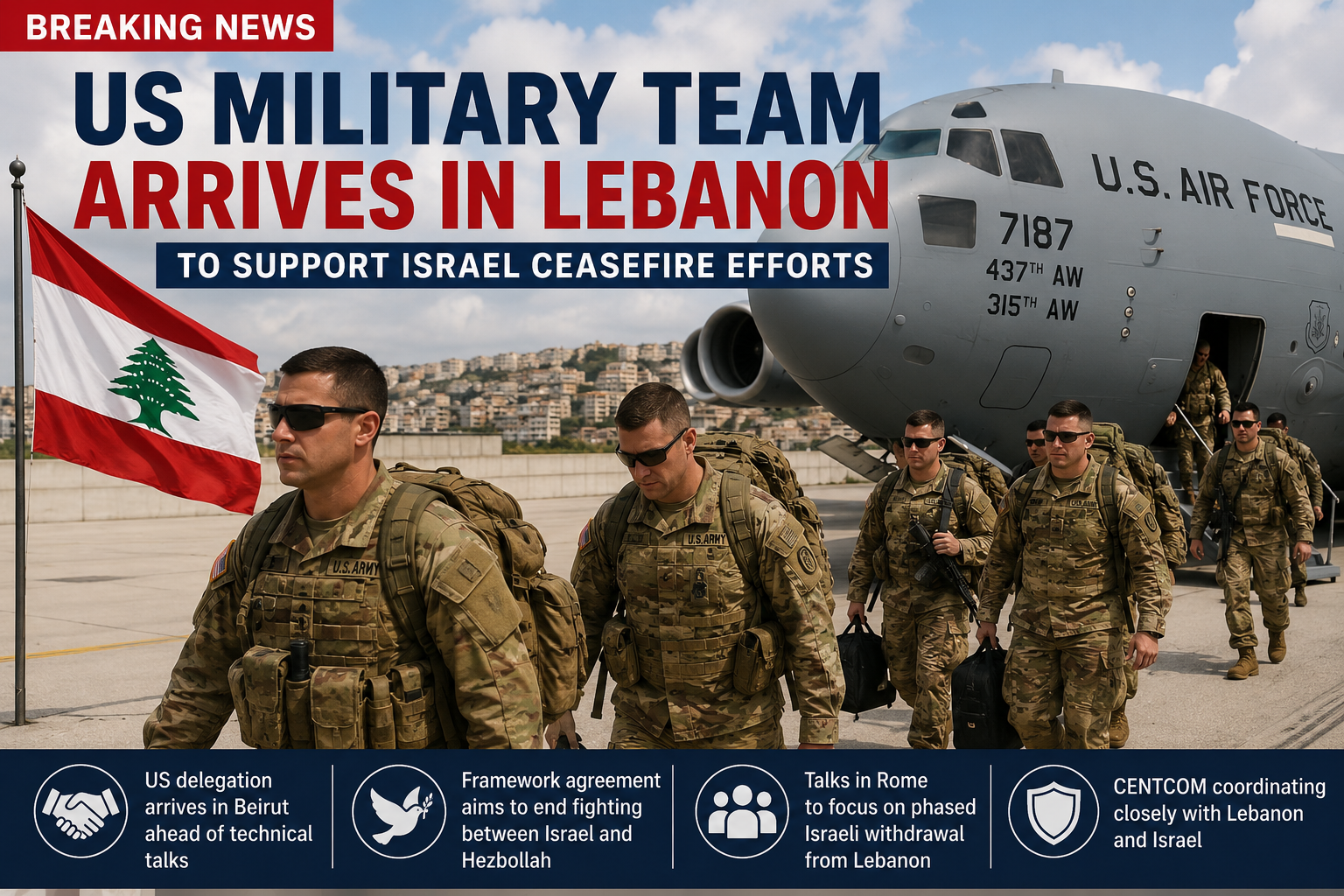
US Military Team Arrives in Lebanon to Support Israel Ceasefire Efforts
The United States has deployed a military delegation to Lebanon as part of renewed efforts to strengthen the ceasefire agreement between Israel and Hezbollah. The move comes as both countries prepare for technical negotiations aimed at implementing a US-backed framework designed to reduce tensions and promote long-term stability along the Israel-Lebanon border.
According to reports, the US military delegation arrived in Beirut ahead of important talks expected to take place in Rome. The discussions will focus on carrying out the framework agreement reached on June 26, which outlines a phased Israeli withdrawal from parts of southern Lebanon.
The deployment highlights Washington’s continued involvement in Middle East diplomacy as regional tensions remain high.
US Military Team Arrives in Lebanon to Support Israel Ceasefire Efforts
The arrival of the US military team marks another significant step in implementing the ceasefire framework agreed upon by Israel and Lebanon.
Officials familiar with the negotiations said the delegation was sent by the US Central Command (CENTCOM) to provide technical and military coordination during the implementation process.
The delegation will work closely with both governments to ensure that commitments made under the agreement are carried out effectively.
Diplomatic sources believe the mission is intended to reduce the risk of renewed clashes while improving communication between both sides.
US-Backed Framework Agreement Moves to Implementation Stage
The ceasefire framework was reached with US support and aims to gradually reduce military tensions between Israel and Hezbollah.
The agreement includes several confidence-building measures, including a phased withdrawal of Israeli forces from designated areas in southern Lebanon.
According to US officials, both countries have now entered the implementation phase of the agreement.
If successfully completed, the framework could become an important step toward improving security and stability across the border.
CENTCOM Takes Lead Role
The United States Central Command (CENTCOM) is overseeing military coordination for the agreement.
Its role includes monitoring implementation, supporting communication between military officials, and helping prevent misunderstandings that could trigger further violence.
CENTCOM has played an important role in several regional security operations and continues to support diplomatic initiatives across the Middle East.
Lebanon and Israel Prepare for Technical Talks
Senior officials from Lebanon and Israel are expected to meet in Rome next week for technical discussions regarding the agreement.
The talks will focus on practical measures needed to implement the ceasefire framework.
Military experts are expected to discuss border security, troop movements, monitoring mechanisms, and timelines for the phased Israeli withdrawal.
The negotiations are viewed as a crucial test of both sides’ commitment to reducing tensions.
Israeli Withdrawal Expected in Phases
One of the key elements of the agreement is the gradual withdrawal of Israeli forces from selected areas inside Lebanese territory.
Officials say the first pilot zone could begin within days if both parties fulfill their initial commitments.
The phased approach is intended to build trust while minimizing security risks for civilians living near the border.
International observers believe successful implementation could encourage further diplomatic progress.
Why the Ceasefire Matters
The border between Israel and Lebanon has experienced repeated military confrontations over the years.
Cross-border attacks, rocket fire, and military operations have displaced thousands of civilians and damaged infrastructure on both sides.
The latest ceasefire framework aims to prevent another major conflict while creating conditions for long-term regional stability.
Analysts believe reducing tensions would also improve humanitarian conditions and allow displaced families to return home safely.
Regional Stability Remains a Priority
The Middle East continues to face multiple security challenges.
Conflicts in neighboring countries and ongoing political tensions have increased concerns about broader regional instability.
Diplomatic efforts involving the United States, European partners, and regional governments seek to prevent local conflicts from expanding into wider military confrontations.
The Lebanon-Israel agreement is viewed as an important part of those broader peace efforts.
US State Department Confirms Coordination
A spokesperson for the US State Department confirmed that CENTCOM is coordinating closely with both Lebanon and Israel throughout the implementation process.
According to US officials, communication remains active between military representatives, diplomats, and international partners.
Washington believes sustained dialogue is essential for ensuring the agreement succeeds.
Officials also expressed optimism that the first phase of implementation could begin within days.
International Support for the Agreement
Several international partners have welcomed the progress made so far.
Diplomatic observers believe outside support will help maintain transparency during implementation and encourage both sides to honor their commitments.
Continued monitoring may also reduce misunderstandings that have previously contributed to renewed violence.
Iran Responds to US Actions
While diplomatic efforts continue between Israel and Lebanon, Iran has criticized the United States over separate issues related to sanctions and previous agreements.
Iranian Foreign Minister Abbas Araghchi accused Washington of failing to fully honor earlier commitments and warned that future cooperation depends on mutual compliance.
His comments highlight the broader political tensions that continue to influence regional diplomacy.
Although Iran’s concerns relate to separate negotiations, analysts believe they could still affect the overall security environment in the Middle East.
Diplomatic Challenges Continue
Despite positive developments surrounding the Lebanon ceasefire, significant diplomatic challenges remain.
Political disagreements, security concerns, and regional rivalries continue to complicate negotiations involving multiple countries.
Experts believe long-term peace will require continued dialogue, confidence-building measures, and international cooperation.
What Happens Next?
The upcoming technical talks in Rome are expected to determine how quickly the agreement moves forward.
If both parties successfully complete the first implementation phase, additional withdrawals and security measures could follow over the coming weeks.
Military observers will closely monitor developments on the ground to ensure compliance with agreed timelines.
Success could reduce tensions along one of the Middle East’s most sensitive borders.
Conclusion
The arrival of the US Military Team in Lebanon to Support Israel Ceasefire Efforts represents an important step toward implementing a US-backed agreement designed to reduce hostilities between Israel and Hezbollah. With CENTCOM coordinating military cooperation and technical talks scheduled in Rome, both sides are entering a critical stage of the peace process.
While regional political challenges remain, the phased withdrawal plan and ongoing diplomatic engagement offer cautious hope for greater stability along the Lebanon-Israel border. The coming days will be crucial in determining whether the agreement can deliver lasting peace and strengthen security across the region.
- U.S. Central Command (CENTCOM)
- U.S. Department of State
- United Nations Interim Force in Lebanon (UNIFIL)
- Reuters – Middle East News
- Financial Times
- Anadolu Agency
